
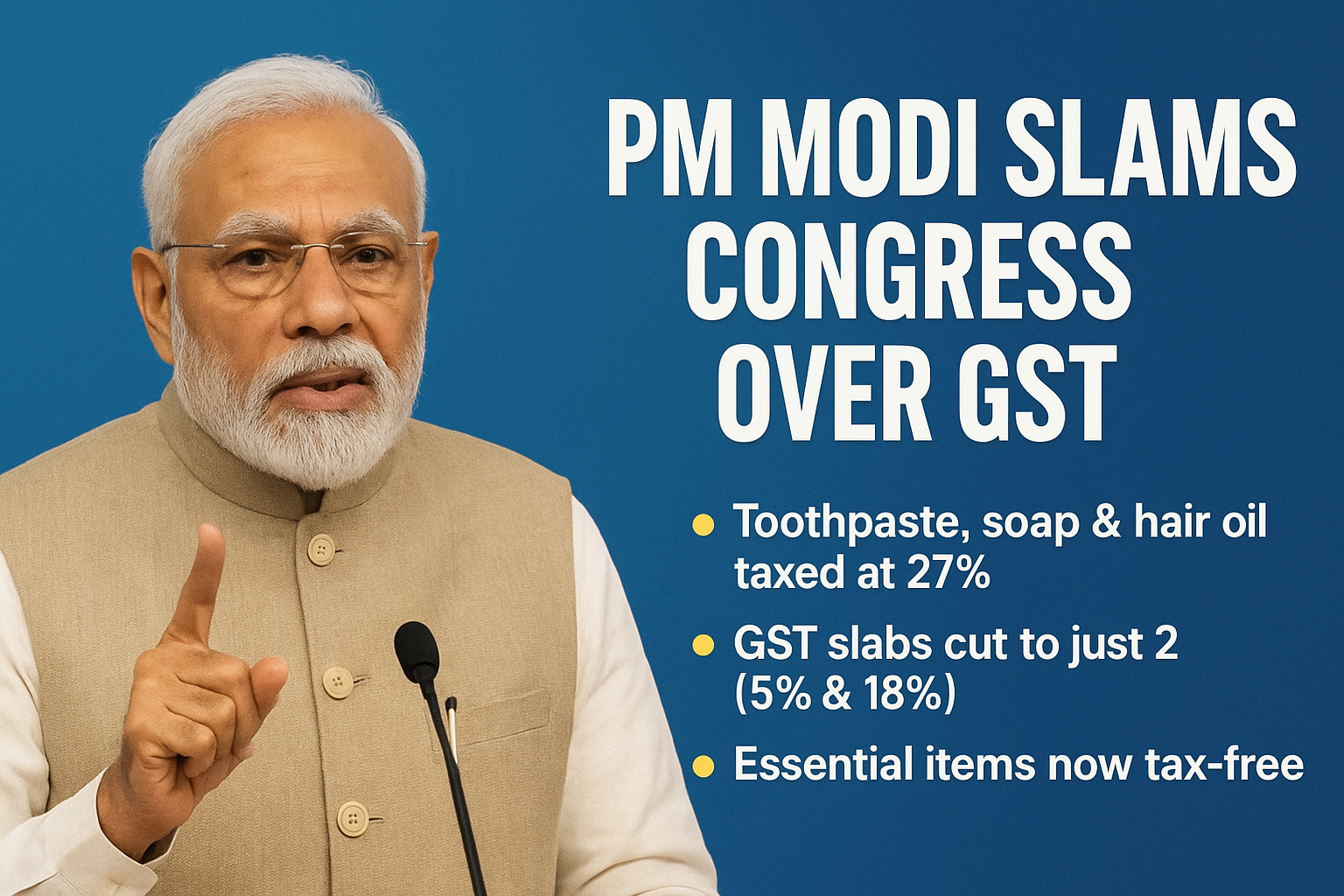
GST Rationalisation: Modi Criticises Congress for Taxing Essentials
New Delhi: PM Modi Slams Congress for Heavy Taxes, Welcomes GST Rationalisation
Prime Minister Narendra Modi, while speaking on the rationalisation of the Goods and Services Tax (GST), strongly criticised the Congress for what he called excessive taxation on everyday needs. According to him, the Opposition taxed almost everything — from food and medicine to household essentials.
The Congress, however, has dismissed the reforms, arguing that the decision has come “eight years too late.” It has also questioned the timing, linking the announcement to upcoming Bihar assembly elections and the recent 50% tariff hike by US President Donald Trump.
Modi’s Sharp Counterattack
Responding to the criticism, PM Modi reminded people of the situation before 2014. He said that during the Congress era, even the simplest items attracted steep taxes.
For instance, toothpaste, soap, and hair oil carried a 27% tax, while plates, cups, and spoons were taxed between 18% and 28%. Everyday items such as tooth powder had a 17% tax, and even children’s toffees were taxed at 21%.
He also highlighted that cycles — a necessity for crores of Indians — had a 17% tax, while sewing machines, which provide self-employment for women, faced 16% tax. Building houses was difficult due to a 29% tax on cement, and travel became costlier with a 14% tax on hotel rooms. In addition, consumer goods like televisions, air conditioners, and fans were taxed as high as 31%.
“Before 2014, farming was expensive and farmers earned very little. The main reason was the heavy tax burden Congress placed on agricultural products,” Modi added.
GST Reforms Announced
The GST Council, in its latest decision, has reduced the earlier four tax slabs to just two — 5% and 18%. As a result, taxes have been cut on a wide range of products, including food, medicines, farm goods, renewable energy items, small cars, and two-wheelers.
In addition, essential items such as life insurance, medical insurance, dairy products, bread, and life-saving drugs have been made completely tax-free.
❓ Frequently Asked Questions (FAQs) on GST Reform 2025
Q1. What did PM Modi say about GST and Congress?
PM Modi criticised the Congress, saying they taxed almost everything — from toothpaste and soap to even children’s toffees. He highlighted that his government has simplified GST to reduce the burden on common people.
Q2. What are the new GST slabs announced in 2025?
The GST Council has reduced four tax slabs to just two — 5% and 18%. This simplification is aimed at making the tax system easier and more consumer-friendly.
Q3. Which items are now tax-free under GST?
Essential items such as food (dairy, bread), medicines, life and medical insurance, and life-saving drugs have been made GST-exempt.
Q4. Why has the GST rationalisation been criticised by Congress?
The Congress called the move “eight years too late” and questioned its timing, linking it to the upcoming Bihar elections and global trade issues like the US tariff hike.
Q5. How will the GST reform benefit common people?
The reform will reduce the cost of everyday goods, make essentials tax-free, and simplify the overall tax system. It is expected to increase savings for households and boost consumption.
Q6. When will the new GST slabs take effect?
The new GST structure will be implemented from September 22, 2025, starting on the first day of Navratri.
